
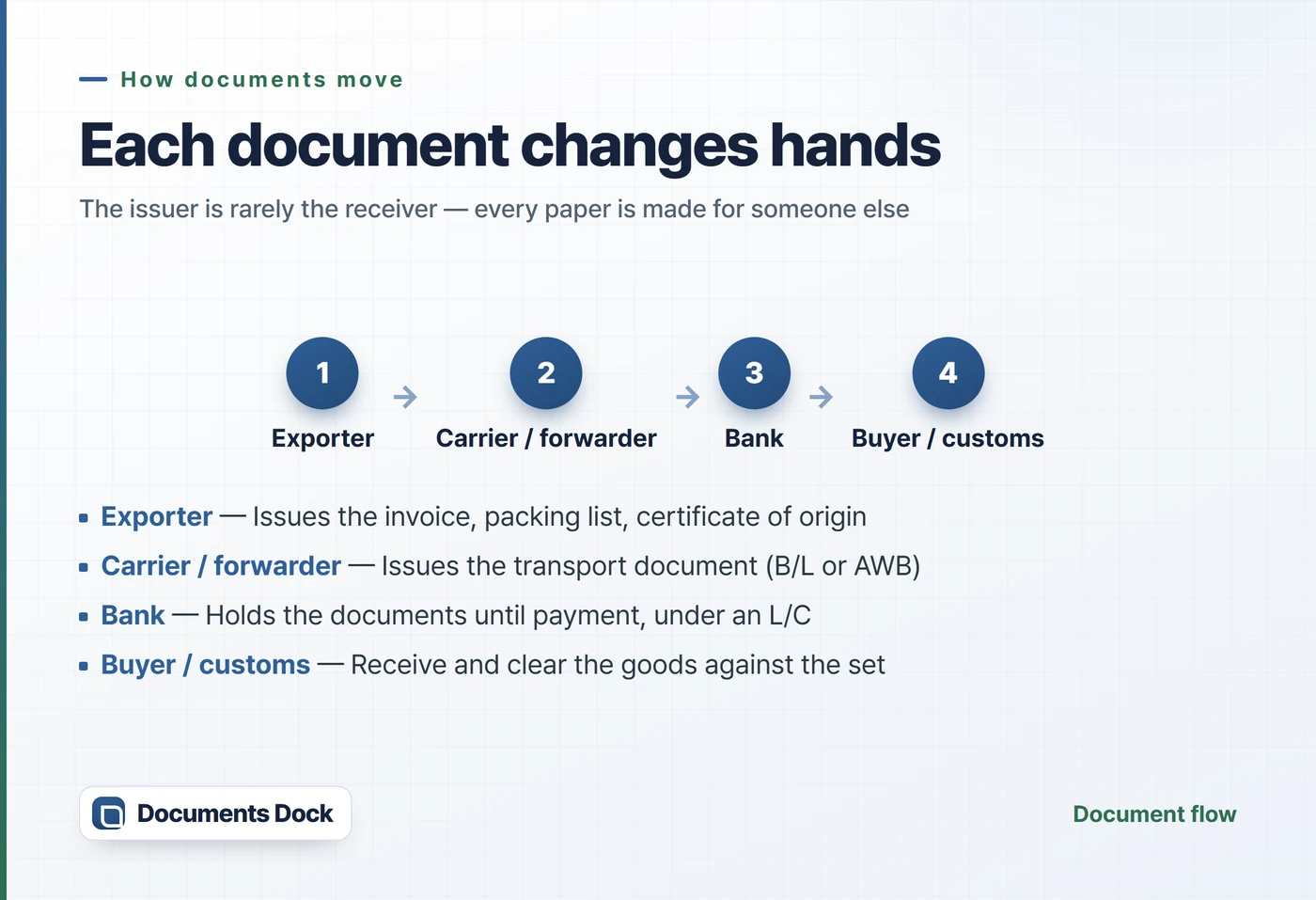
A single export is one shipment, but it produces a small stack of documents — and each one comes from a different hand, at a different moment, and lands on a different desk. New exporters tend to learn the names first. The faster path is to learn the order: who triggers each document, when, and who receives it.
This guide maps the set and the sequence. It is the structure hub the rest of our guides link into. For any single document in depth, follow the links in each section — this page is the spine, not the deep-dive entry.
A quick scope note before we start: this covers the core set most goods shipments share. It is not every document for every trade lane. Controlled goods, food, chemicals, and preferential-tariff claims add their own paperwork, and your terms of sale decide whether some of these appear at all.
How to read the sequence
Two ideas make the whole set click.
First, documents follow events. A commercial invoice exists because a sale happened. A transport document exists because a carrier took the goods. Nothing is generated 'just in case' — each paper is triggered by a real step in the shipment.
Second, the issuer is rarely the receiver. The party who creates a document almost always hands it to someone else who needs it to do their job — a bank, a carrier, a customs broker, or the buyer. Keep asking 'who made this, and who is it for?' and the stack stops feeling random.
One term to retire early: your Incoterms 2020 rule (EXW, FOB, CIF, and the rest) sets who arranges and pays for carriage and insurance, and where risk passes from seller to buyer. A point worth holding onto: who pays is not the same as where risk transfers. Under CIF, for example, the seller pays freight and insurance to the destination port, but risk passes to the buyer once the goods are on board at the origin port. The terms decide whether some documents below are the seller's responsibility at all.
Cost ≠ risk
Under CIF the seller pays freight and insurance all the way to the destination port — but the buyer carries the risk from the moment the goods are on board at the origin port. Who pays and who bears the risk are two different questions.
1. Commercial invoice — the spine of the set
The commercial invoice states what is being sold, to whom, on what terms, and for how much. Customs use it to assess duties and taxes; the bank uses it to release payment; the buyer uses it to account for the purchase. Because so many parties read it, the values on it must agree with every other document in the set.
For the field-by-field breakdown — and the difference between a commercial invoice and a proforma invoice — see our commercial invoice guide.
- Who issues it: the exporter (seller).
- When it is triggered: as soon as the sale is confirmed and goods are ready to ship — it is usually the first document the exporter produces for the shipment.
- Who receives it: the importer (buyer), the customs authority in the destination country (via the buyer or their customs broker), and the bank if payment runs through one.
Watch the values
Product description, quantity, weight, and amount on the invoice must match the packing list, the transport document, and any certificate. A single mismatch is the most common trigger for a customs hold or a letter-of-credit refusal.
2. Packing list — what is physically in the boxes
The packing list translates the invoice into physical reality: number of cartons, net and gross weights, dimensions, and how items are distributed across packages. It does not repeat prices. Its job is to let anyone handling or inspecting the shipment confirm that the boxes match the paperwork — for instance, that '1,000 pieces' on the invoice is not quietly '1,000 sets' in the container, or that a gross weight of 12.5 t lines up with the carrier's measurement.
- Who issues it: the exporter (seller).
- When it is triggered: when the goods are packed, alongside or just after the commercial invoice.
- Who receives it: the freight forwarder and carrier (to plan and verify the load), the customs authority (to inspect against the declaration), and the buyer (to check receipt).
3. Transport document — proof the carrier took the goods
This is the document that changes shape depending on how the goods move:
- Who issues it: the carrier or the freight forwarder, on behalf of the carrier — not the exporter.
- When it is triggered: when the goods are handed over to the carrier and loaded for the main leg of the journey.
- Who receives it: for a negotiable bill of lading, the exporter first (as the shipper), who then routes it to the importer — directly, or through the bank when payment terms require it. For a straight air waybill, the carrier issues it to the named consignee from the outset, so it is not routed for control the way a negotiable B/L is.
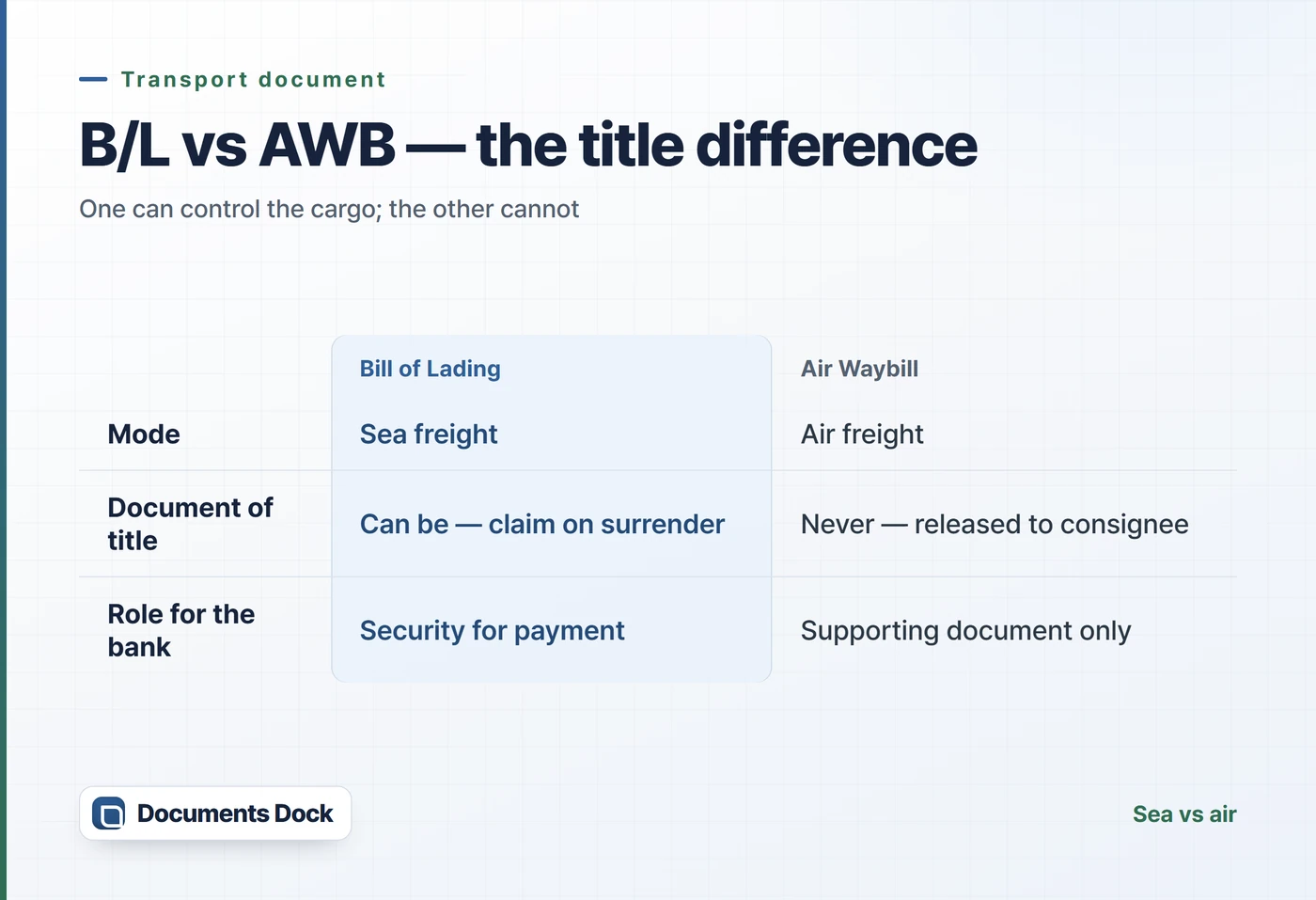
That single difference — title versus no title — changes how payment and cargo release work, so it is worth understanding before you choose a payment method. We cover it in full in Bill of Lading vs Air Waybill.
- Sea freight → Bill of Lading (B/L). A B/L can serve as a document of title, meaning whoever holds the original endorsed copy can claim the goods. That property makes it central to bank-controlled payment.
- Air freight → Air Waybill (AWB). An AWB is a receipt and a contract of carriage, but it is not a document of title. The goods are released to the named consignee, not to whoever holds the paper.
4. Certificate of origin — where the goods were made
A certificate of origin states the country where the goods were produced. There are two broad kinds, and they are not interchangeable: a non-preferential certificate simply attests origin, while a preferential one supports a reduced or zero duty rate under a specific trade agreement and must meet that agreement's origin rules. It fails more often on inconsistency with the invoice than on issuance — so the origin, descriptions, and values must match the rest of the set.
This document is conditional. Plenty of shipments never need one. Whether yours does depends on the goods and the destination — confirm with a licensed customs broker or the relevant authority.
- Who issues it: the exporter prepares it, but it is typically certified by an authorised body — often a chamber of commerce, or another authority designated in the destination market's rules — or, under some trade agreements, self-certified by the exporter, producer, or importer.
- When it is triggered: during or just after shipment preparation, once the goods and their origin are confirmed — and only when the destination country or a trade agreement calls for one.
- Who receives it: the importer and the customs authority at destination, sometimes via the bank.

5. Insurance certificate — cover for the goods in transit
This certificate is also conditional, and the terms decide it. Under CIF (sea) and CIP (any mode), the seller is obliged to arrange transit insurance for the buyer's benefit, so an insurance certificate becomes part of the set the seller provides. Under most other Incoterms rules, insurance is optional and whoever holds the risk decides whether to buy cover. Recall the earlier point: the seller paying for that insurance under CIF does not mean the seller carries the risk once the goods are on board.
- Who issues it: the insurer or insurance broker, arranged by whichever party the Incoterms rule makes responsible.
- When it is triggered: before the goods leave, so cover is in place for the main carriage.
- Who receives it: the party bearing the risk in transit, and the bank when it is a required document under the payment terms.
The sequence at a glance
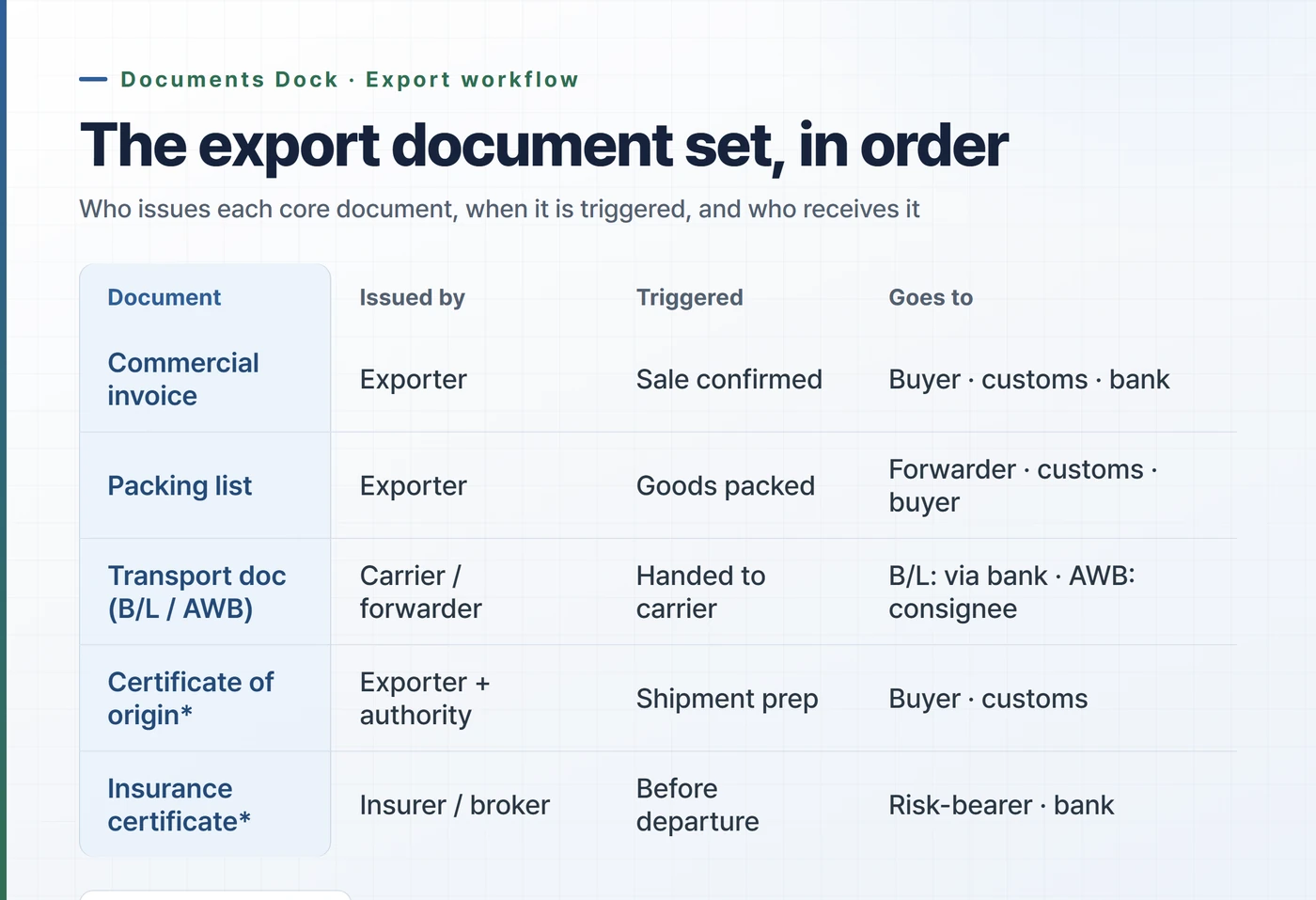
Read top to bottom, the pattern is clear: the exporter opens the set with the invoice and packing list, the carrier adds proof of carriage, and the conditional documents attach only when the goods, the destination, or the terms call for them. The same values — descriptions, quantities, weights, amounts — should trace cleanly across all of them.
For a closer look at which party is accountable for the first three documents, see Who issues your CI, PL and B/L.
- 1. Commercial invoice — issued by the exporter when the sale is confirmed; goes to the buyer, customs, and the bank.
- 2. Packing list — issued by the exporter when the goods are packed; goes to the forwarder, carrier, customs, and buyer.
- 3. Transport document (B/L / AWB) — issued by the carrier or forwarder when the goods are handed to the carrier; a B/L routes exporter → buyer (via bank if required), while an AWB goes to the named consignee direct.
- 4. Certificate of origin (if applicable) — prepared by the exporter and certified by an authorised body, or self-certified by the exporter, producer, or importer under some agreements; triggered at shipment prep; goes to the buyer and customs.
- 5. Insurance certificate (if CIF/CIP) — issued by the insurer or broker before departure; goes to the risk-bearing party and the bank.
Sources
This is general information, not a compliance ruling. Which documents your shipment actually needs — and whether a certificate, insurance, or specific declaration applies — depends on your goods, the countries involved, and your terms of sale. Confirm the set for your lane with a licensed customs broker or the relevant authority.
- U.S. International Trade Administration (ITA), Common Export Documents — trade.gov/common-export-documents
- ICC, Incoterms 2020 rules — iccwbo.org/business-solutions/incoterms-rules/incoterms-2020
- World Customs Organization, Revised Kyoto Convention — wcoomd.org
- U.S. ITA, FTA Certificates of Origin — trade.gov/fta-certificates-origin