
An Indian export looks finished when the vessel sails. On paper it isn't — the file stays open until your bank reports the money.
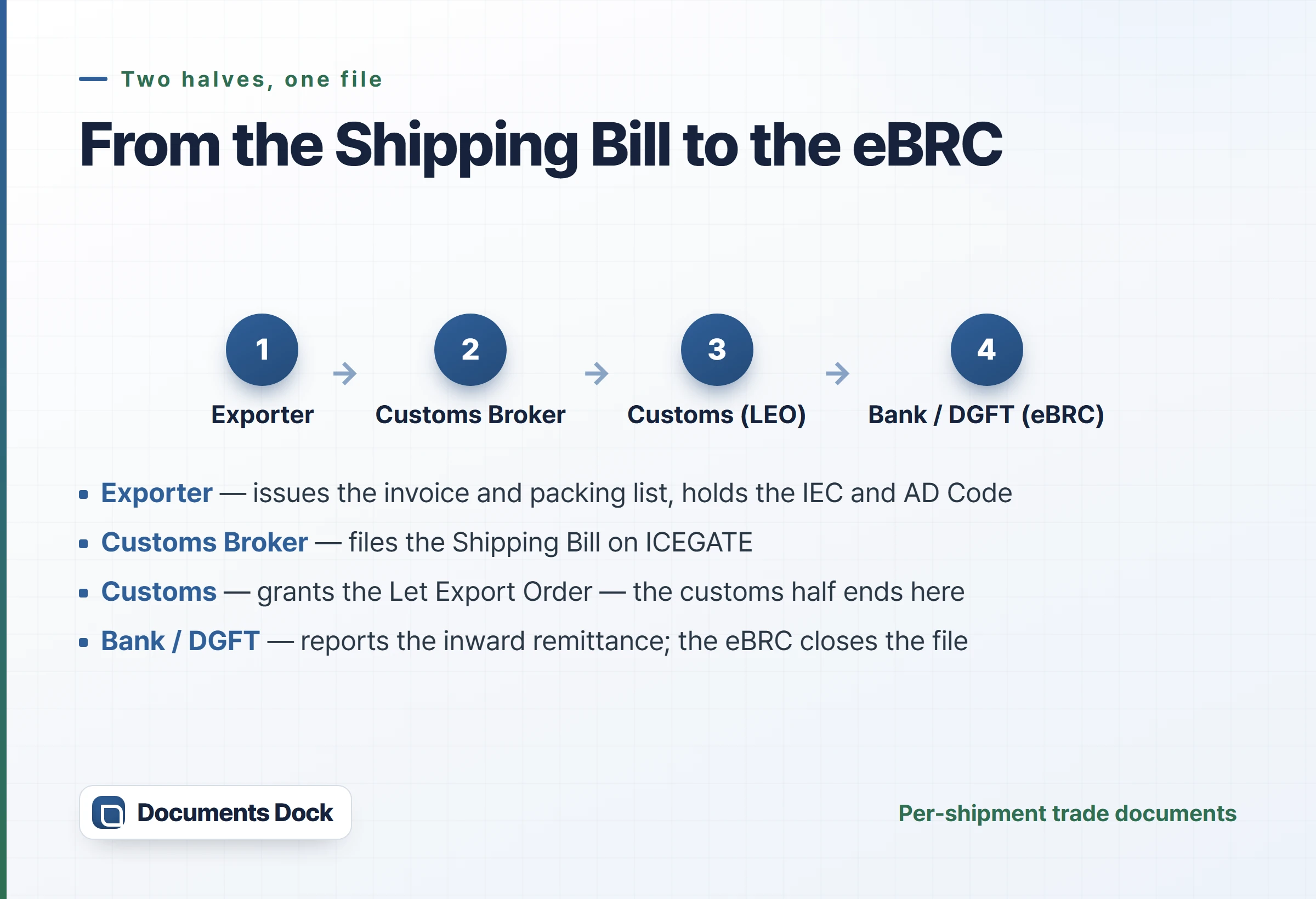
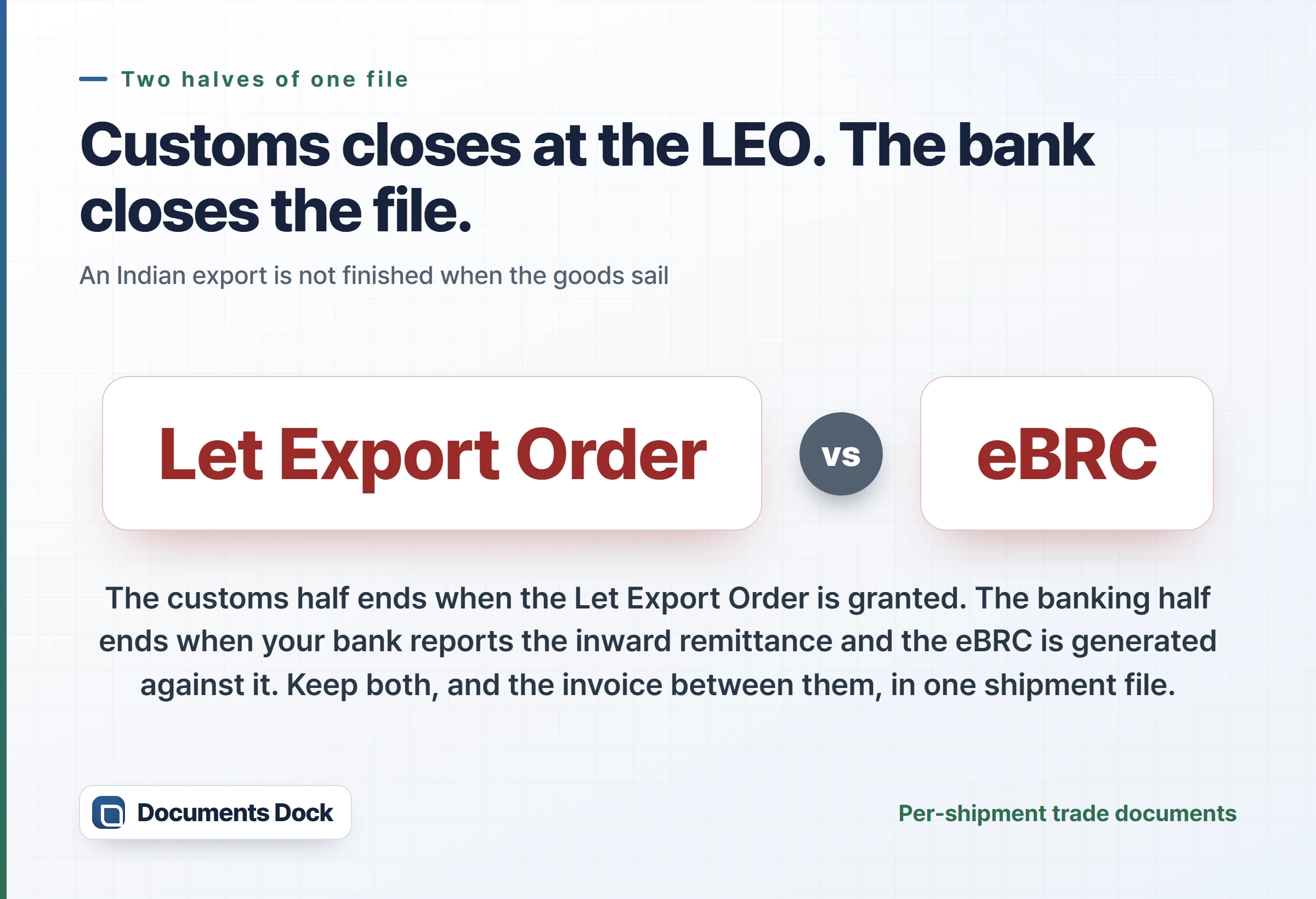
An Indian export document trail runs in two halves: the customs half, which ends when the Shipping Bill is filed on ICEGATE and the Let Export Order is granted, and the banking half, which ends when the exporter's bank reports the inward remittance and an eBRC is generated against it on the DGFT platform.
Most exporters manage the first half well and lose track of the second. That is understandable — the goods are gone, the invoice is issued, and the shipment feels closed. But the paperwork that proves an export happened and the paperwork that proves it was paid for are held by different parties, arrive weeks apart, and are matched to each other later. Treating them as one file from the start is what makes the second half quiet.
Who files the Shipping Bill in India?
For most commercial exports from India, the goods are declared on a Shipping Bill filed electronically through ICEGATE, the Indian Customs EDI gateway — usually by a licensed Customs Broker acting for the exporter. Customs then examines the consignment as required and grants the Let Export Order, which is the permission for the goods to leave.
The Broker files, but from what you hand over. The commercial invoice and packing list are yours; the transport document comes from the carrier or forwarder; the identity references come from DGFT and your bank. A Broker can flag that two of your documents disagree, but they cannot decide which figure is correct — that decision sits with you and your buyer.
Two identity references sit underneath all of it. Your Importer-Exporter Code (IEC), issued by DGFT, is the trader identifier without which the export cannot be declared. Your bank's Authorised Dealer (AD) Code has to be registered at the port you are exporting from, so that the shipment and its future payment can be tied together. An IEC that is fine and an AD Code that was never registered at that particular port is a common, avoidable stop.
What is an eBRC, and who creates it?
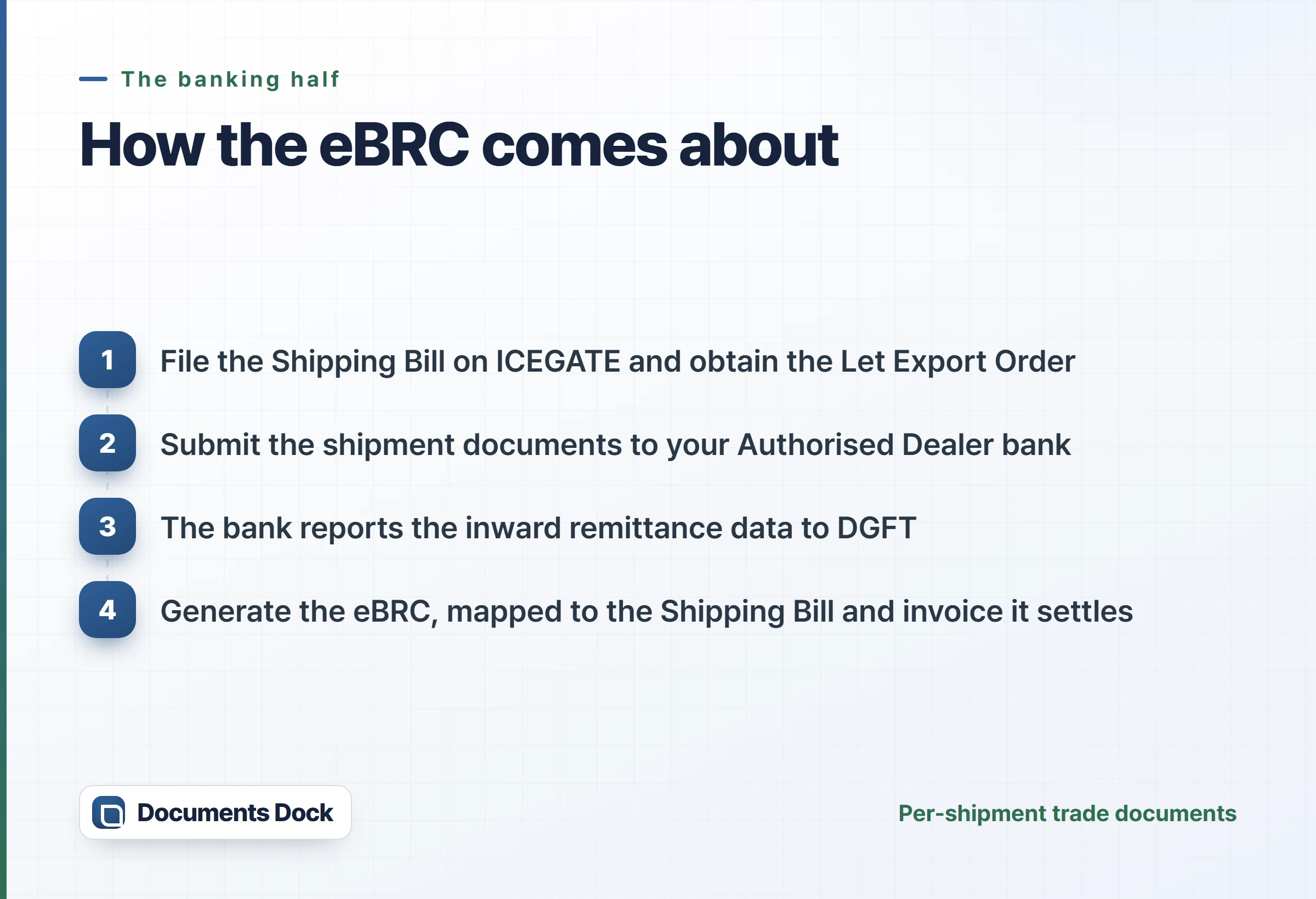
An eBRC — electronic Bank Realisation Certificate — is the record on the DGFT platform that export proceeds for a shipment were received in India. The sequence matters: the bank transmits the inward remittance data to DGFT first, and only then does the exporter generate the eBRC against that data, mapping the remittance to the Shipping Bill and invoice it belongs to. It is the standard evidence that an export was actually paid for.
That mapping step is where the practical work is. A remittance rarely arrives labelled with the shipping bill it settles. One payment may cover several invoices, a buyer may net a deduction, or an advance may be adjusted against a later shipment. Whoever generates the eBRC has to reconstruct which money answered which shipment — easy in the same week, tedious a quarter later.
This matters beyond tidiness. The eBRC is what export benefit schemes and later queries rely on, and it is the exporter's own evidence that the shipment was closed properly. Whether a specific scheme or filing applies to your goods is a question for your Customs Broker, your bank, or DGFT — but the underlying discipline is the same either way: keep the money traceable to the shipment.
One remittance is not always one shipment
Match the money to the shipment while you still remember the deal — one payment covering three invoices, or a buyer's deduction, is far harder to reconstruct months later than on the day it lands.
What happens if export proceeds aren't realised?
Export proceeds are expected to be received within the period allowed under India's foreign-exchange rules, and an export that stays unrealised past that point becomes an open item your bank will raise with you. The rules, the period, and the available extensions are set by the Reserve Bank of India and administered through your Authorised Dealer bank, so the specifics for your shipment are a question for that bank — not something to assume from a general guide.
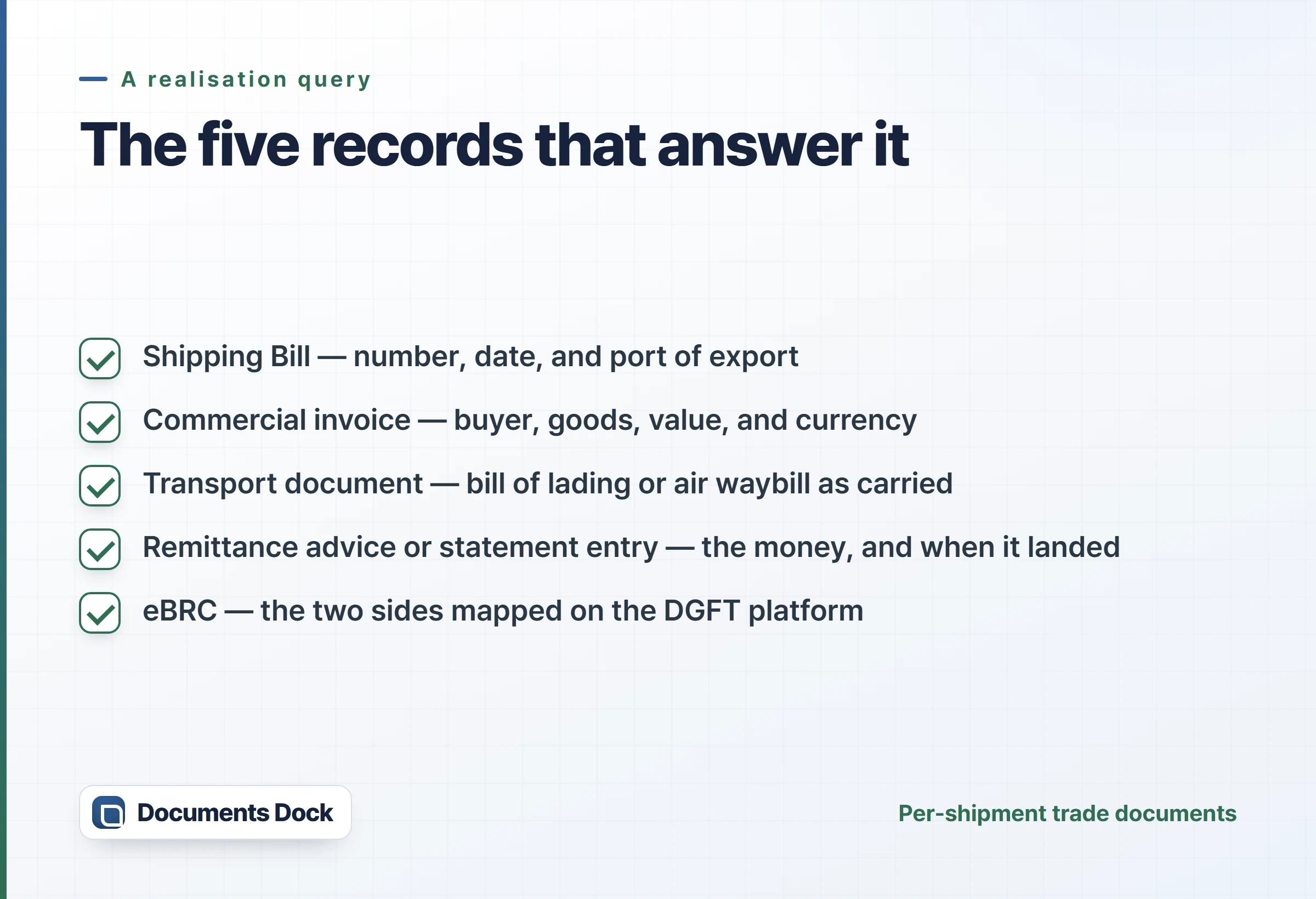
What you can control is whether the answer is findable. When a bank or an authority asks about an old shipment, the request is almost never for one document; it is for the set that shows the same shipment from three angles:
- The Shipping Bill — the export as declared, with its number, date, and port.
- The commercial invoice it was filed against — the buyer, goods, value, and currency.
- The transport document — the bill of lading or air waybill as carried.
- The remittance advice or bank statement entry — the money that arrived, and when.
- The eBRC — the two sides mapped to each other on the DGFT platform.
An unrealised export doesn't close itself
A shipment that left India but was never paid for stays open in your bank's records until it is realised, extended, or written off under the applicable rules. Confirm the position and the options for your shipment with your Authorised Dealer bank.
Keep the shipment and its realisation in one file
The fix is not more paperwork; it is keeping the two halves in the same place from the beginning, so the second half is a lookup instead of an investigation. The same suppliers, ports, and buyers come back shipment after shipment, so a habit set once keeps paying:
- Confirm the IEC and the AD Code registration at the port of export before the goods move, not while the Broker is waiting.
- Reconcile quantities, weights, value, and currency across invoice, packing list, and transport document before your Broker files — the same discipline as any customs submission.
- Record the Shipping Bill number and date against the invoice it was filed for, as soon as the Let Export Order comes through.
- When the remittance lands, note which invoices it settles, then generate the eBRC against that mapping and keep it with the shipment.
Before your Broker files
Keep received documents and issued copies side by side, per shipment, with Documents Dock — so the Shipping Bill, the invoice it was filed against, and the eBRC stay in one place instead of three inboxes. Start at documentsdock.com.
This is general information, not a compliance ruling. Whether a specific filing, scheme, duty, or realisation period applies to your shipment depends on your goods, your buyer, and the current rules — confirm with a licensed Customs Broker, your Authorised Dealer bank, or the relevant authority.
- Directorate General of Foreign Trade (DGFT), India — dgft.gov.in (IEC, eBRC)
- Indian Customs EDI Gateway (ICEGATE) — icegate.gov.in (Shipping Bill filing)
- Central Board of Indirect Taxes and Customs (CBIC), India — cbic.gov.in (customs procedure and tariff)
- Reserve Bank of India — rbi.org.in (realisation of export proceeds, administered through your Authorised Dealer bank)