
A deposit clears on a Friday against a document the seller still calls a quotation. From that moment the price, the delivery basis and the payment terms typed on it are what the seller owes.
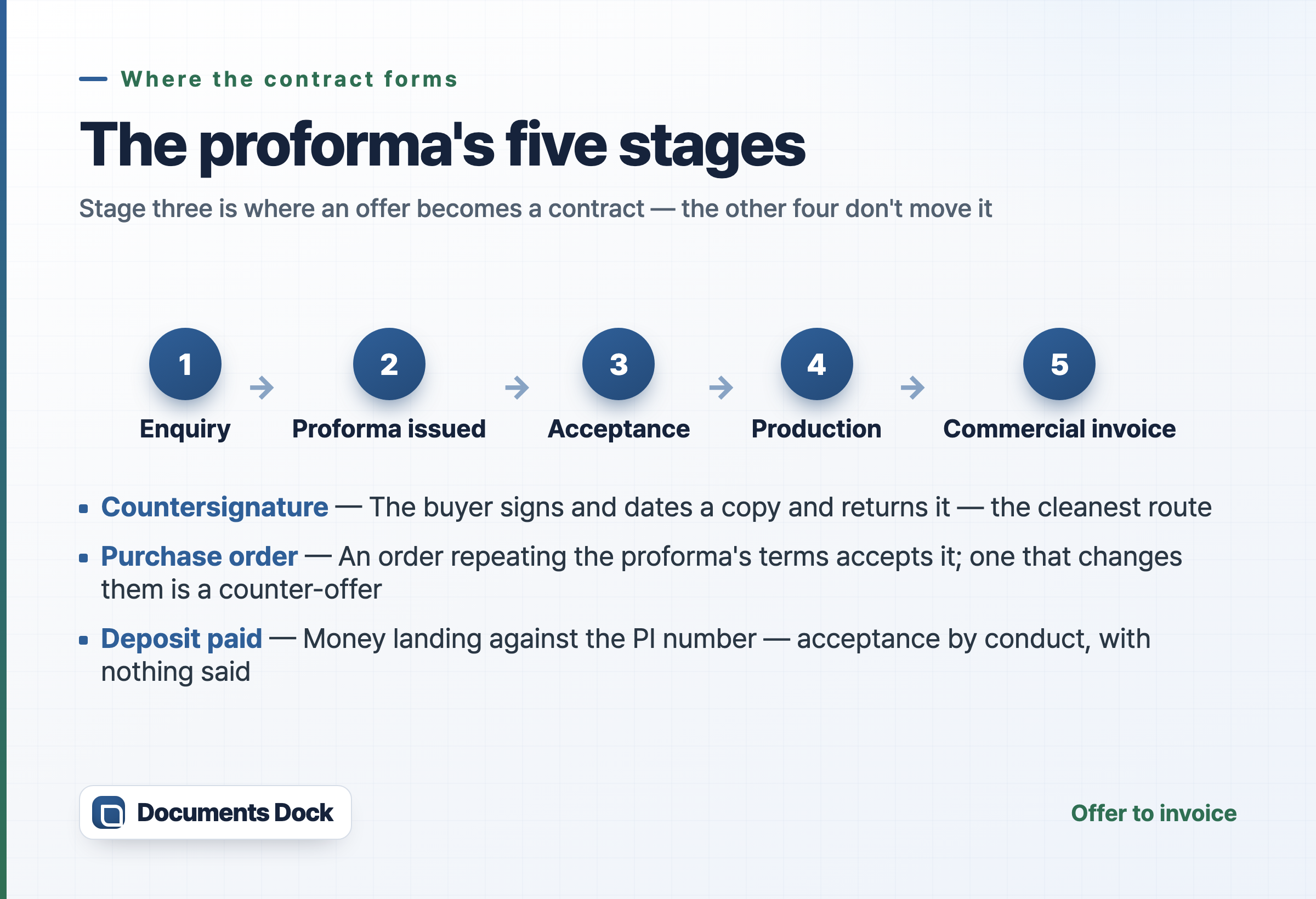
A proforma invoice is not binding in itself. It is an offer set out in invoice form — a quotation with a document number. It becomes binding when the buyer accepts it: by countersigning it, by issuing a purchase order on its terms, by paying the deposit it asks for, or when a signed sales contract adopts it by reference.
If what you need is the invoice that replaces it, start with how to write a commercial invoice.
A proforma does three jobs — none of them accounting for a sale
A proforma is a priced offer issued before the sale is concluded, formatted like an invoice so the buyer's finance team, bank and authorities can act on it. Sellers write one as an estimate, which is why they are surprised when one binds.
It gives the buyer something definite to accept — goods, quantity, unit price, currency, delivery basis, validity. It gives them something to pay a deposit against, since the commercial invoice is not written until shipment. And it carries applications made before production — an import licence, a foreign-exchange approval, the buyer's credit application — which is why proformas travel further than their authors expect.
None of the three makes it an invoice in the accounting sense: not a receivable, and in VAT and GST jurisdictions not a tax invoice, so no input-tax claim rests on it. A deposit may trigger an advance-payment tax invoice of its own.
When does a proforma invoice become binding?
A proforma binds when the buyer's words or conduct accept it, or when another document adopts its terms. A document signed only by the side making the offer is still an offer.
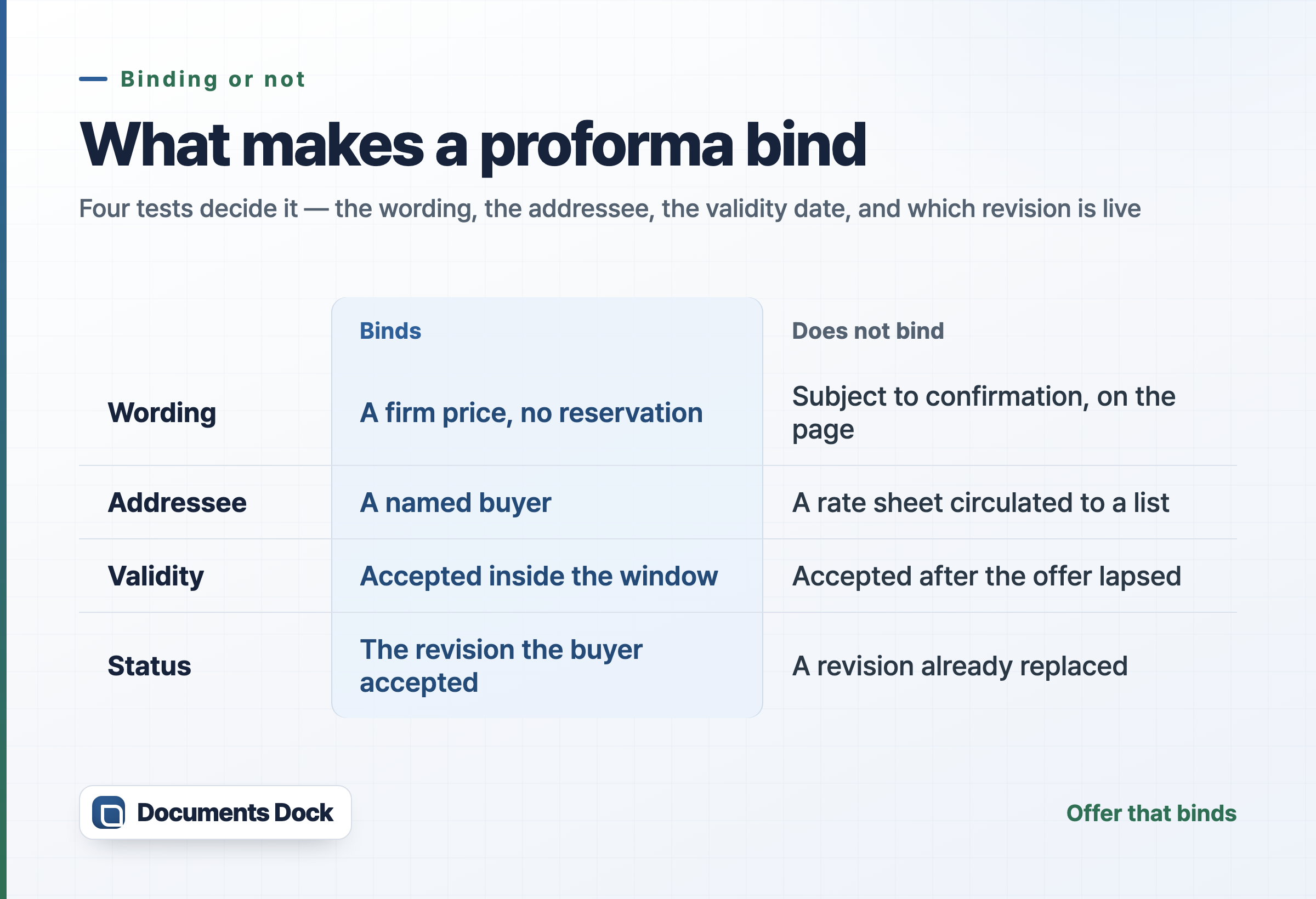
For cross-border sales the usual reference is the UN Convention on Contracts for the International Sale of Goods (CISG). It applies of its own force where both parties are in contracting states (article 1(1)(a)), otherwise where the governing law is that of a contracting state, unless the contract excludes it (article 6) — the United Kingdom and India are not contracting states, and the outcomes below hold under most sales laws anyway. Under article 14(1) an offer names its addressees, indicates the goods, fixes or provides for quantity and price, and shows an intention to be bound.
- **A countersignature.** The buyer signs and dates a copy and returns it, naming the version accepted — the cleanest route, and worth asking for by default.
- **A purchase order on the same terms.** An order repeating the proforma accepts it. One that changes price, payment, quantity, quality, delivery, liability or dispute settlement is a counter-offer (article 19(3)). The trap is the small change: under article 19(2) a non-material addition forms the contract on the buyer's wording unless you object without undue delay.
- **The deposit.** Payment is conduct indicating assent under article 18(1), effective when it reaches you. Where the offer, the parties' practice or usage lets the buyer assent by an act without notifying you, article 18(3) makes it effective the moment the act is performed. Either way the money is acceptance — the deposit clause decides which rule you are in.
- **Incorporation by another document.** A signed sales contract, or the buyer's letter of credit application, naming the proforma by number and date pulls its terms in by reference.
An ignored proforma binds nobody
Article 18(1) is explicit that silence or inactivity does not in itself amount to acceptance: an offer nobody answers stays an offer. What catches sellers is the mirror — an offer answered by an act needs no words.
Four ways a proforma stops short of binding
A proforma stops short where it was never a complete offer, where it has lapsed, or where a later document replaced it.
- **Indicative pricing.** *Subject to confirmation*, *subject to availability*, *budgetary* — none carries the intention to be bound that article 14(1) requires. Put the qualification on the document: one that lives only in a covering email is the one buyers do not read.
- **No named buyer.** A proposal not addressed to specific persons is an invitation to make offers unless clearly indicated otherwise (article 14(2)). A circulated rate sheet is not an offer to anyone on the list.
- **Validity expired.** The offer lapses. Under article 21 you can still take a late acceptance by telling the buyer so without delay — and an acceptance sent in time but delayed in transmission binds you unless you object without delay.
- **Replaced.** A later signed contract, or a revised proforma accepted in its place, displaces the earlier one — but a new revision does not retract the one already accepted.
Does a letter of credit make your proforma binding?
No — not on the bank. A buyer who opens a credit on your proforma's terms is accepting the sale; the credit itself binds the bank to nothing in it. Banks are in no way concerned with or bound by the sale contract even where the credit refers to it (UCP 600 article 4(a)), and article 4(b) tells them to discourage applicants from writing that contract or the proforma into the credit.
The buyer copies your goods description out of the proforma into the credit application, and the issuing bank issues on those words. Article 18(c) then requires your commercial invoice description to correspond with the credit — not word-for-word, since ISBP 745 allows additional data, but with nothing that changes the nature, classification or category of the goods.
The proforma still binds you commercially while the credit ignores it, so check the two against each other the day the credit arrives. If one has landed and does not match, start at why the bank checks your documents, not customs.
What will customs accept a proforma invoice for?
Customs authorities generally accept a proforma where the required commercial invoice is not available at the time of entry, or where there is no sale at all — and generally not as evidence of the price actually paid. Customs value starts from the price actually paid or payable for goods sold for export, plus defined additions — a figure a proforma cannot evidence, since nothing has been paid against it.
Then the proforma stays in the bundle after the commercial invoice exists, and the set carries two prices for one shipment — the replaced-version case in why customs rejects your documents.
Four situations, and the condition attached to all of them.
- **An advance or pre-arrival lodgement** — filed before the goods arrive, when the final invoice does not exist yet.
- **A provisional or incomplete goods declaration** — a Revised Kyoto Convention standard, on an undertaking to complete it.
- **Temporary admission** — under an ATA Carnet the carnet does the work and its general list carries the values; outside it, a proforma does.
- **No sale behind the consignment** — samples, no-charge replacements, goods on consignment.
- **The condition.** The proforma buys time against an undertaking, usually a bond, to produce the commercial invoice by a deadline — in the United States a CBP Form 301 bond and the invoice within 120 days, or 50 where it is needed for statistical purposes.
A price offered is not a price paid
Marking a proforma *value for customs purposes only* settles nothing. Whether one is accepted, and whether release waits on the final invoice, is decided by the destination — confirm the treatment for your goods and route with a licensed customs broker.
Five lines that put the trigger on the document
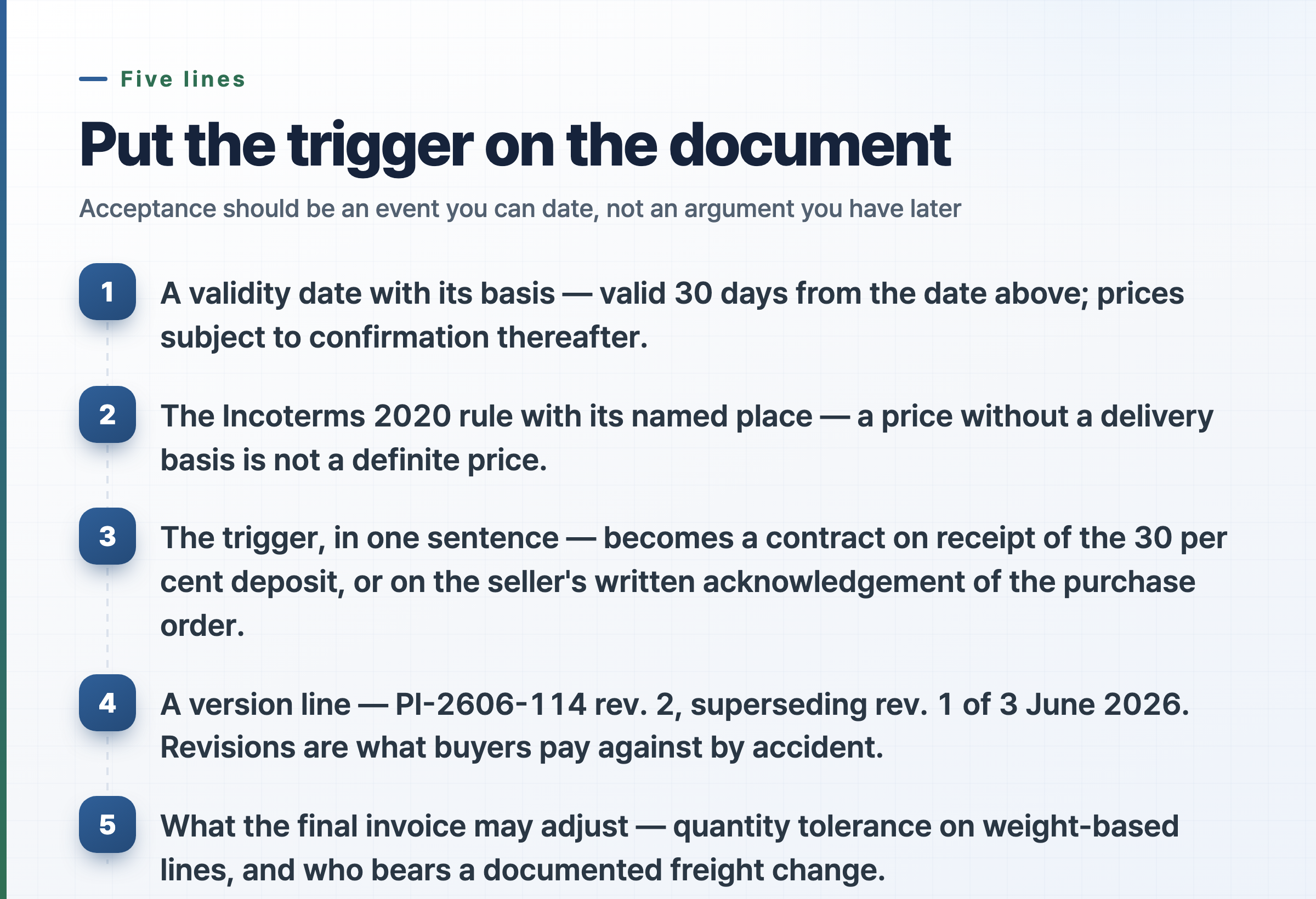
Put the trigger on the document, so acceptance is an event you can date rather than an argument you have later.
- **A validity date with its basis** — *valid 30 days from the date above; prices subject to confirmation thereafter*.
- **The Incoterms 2020 rule with its named place.** A price without a delivery basis is not a comparable price, and leaves cost and risk where the default rules put them rather than where you assumed. Scale the place: port of shipment for FOB, CFR and CIF; place or point of destination for CPT, CIP and the D-rules (who pays for shipping, insurance and customs).
- **The trigger, in one sentence** — *this proforma becomes a contract on receipt of the 30 per cent deposit, or on the seller's written acknowledgement of the buyer's purchase order*.
- **A version line** — *PI-2606-114 rev. 2, superseding rev. 1 of 3 June 2026*. Revisions are what buyers pay against by accident.
- **What the final invoice may adjust** — quantity tolerance on weight-based lines, and who bears a documented freight change.
The revision they paid against is the one that counts
The version the buyer accepted, and the payment that accepted it, is what you will be held to — keep it dated, alongside the commercial invoice that replaces it. The full export document set, in order places both in the sequence.
Documents Dock versions the proforma rather than the thread: every revision is stored with the date it went out, and the deposit that closed one is recorded against that revision by number. Open the shipment and the accepted revision is the first thing you see — documentsdock.com.
Scope, and where this comes from
This is general information, not legal, customs or banking advice. Whether a proforma binds you depends on its wording, the parties' conduct and the governing law; whether an authority accepts one depends on your goods and destination. Guidance calling a proforma the seller's commitment to supply at a stated price is describing a firm offer — a commitment in the commercial sense, which becomes a contract on acceptance. Confirm the position with a qualified lawyer, and the entry with a licensed customs broker.
- UNCITRAL — United Nations Convention on Contracts for the International Sale of Goods (CISG, Vienna 1980), articles 1, 6, 14, 16(2)(a), 18, 19 and 21 — uncitral.un.org/en/texts/salegoods
- International Chamber of Commerce (ICC) — Uniform Customs and Practice for Documentary Credits (UCP 600), articles 4(a), 4(b) and 18(c) — iccwbo.org
- International Chamber of Commerce (ICC) — International Standard Banking Practice (ISBP 745), goods description in the commercial invoice — iccwbo.org
- World Trade Organization — Agreement on Implementation of Article VII of GATT 1994 (customs valuation), articles 1 and 8 — wto.org/english/tratop_e/cusval_e/cusval_e.htm
- World Customs Organization — Revised Kyoto Convention, General Annex Chapter 3, Standard 3.13 (provisional or incomplete goods declarations) — wcoomd.org
- U.S. Customs and Border Protection — 19 CFR 141.85 (pro forma invoice format) and 141.91 (entry without the required invoice, bond and production deadline) — ecfr.gov
- International Chamber of Commerce (ICC) — Incoterms 2020 rules — iccwbo.org/business-solutions/incoterms-rules/incoterms-2020
- U.S. International Trade Administration — Common Export Documents, including the proforma invoice — trade.gov/common-export-documents